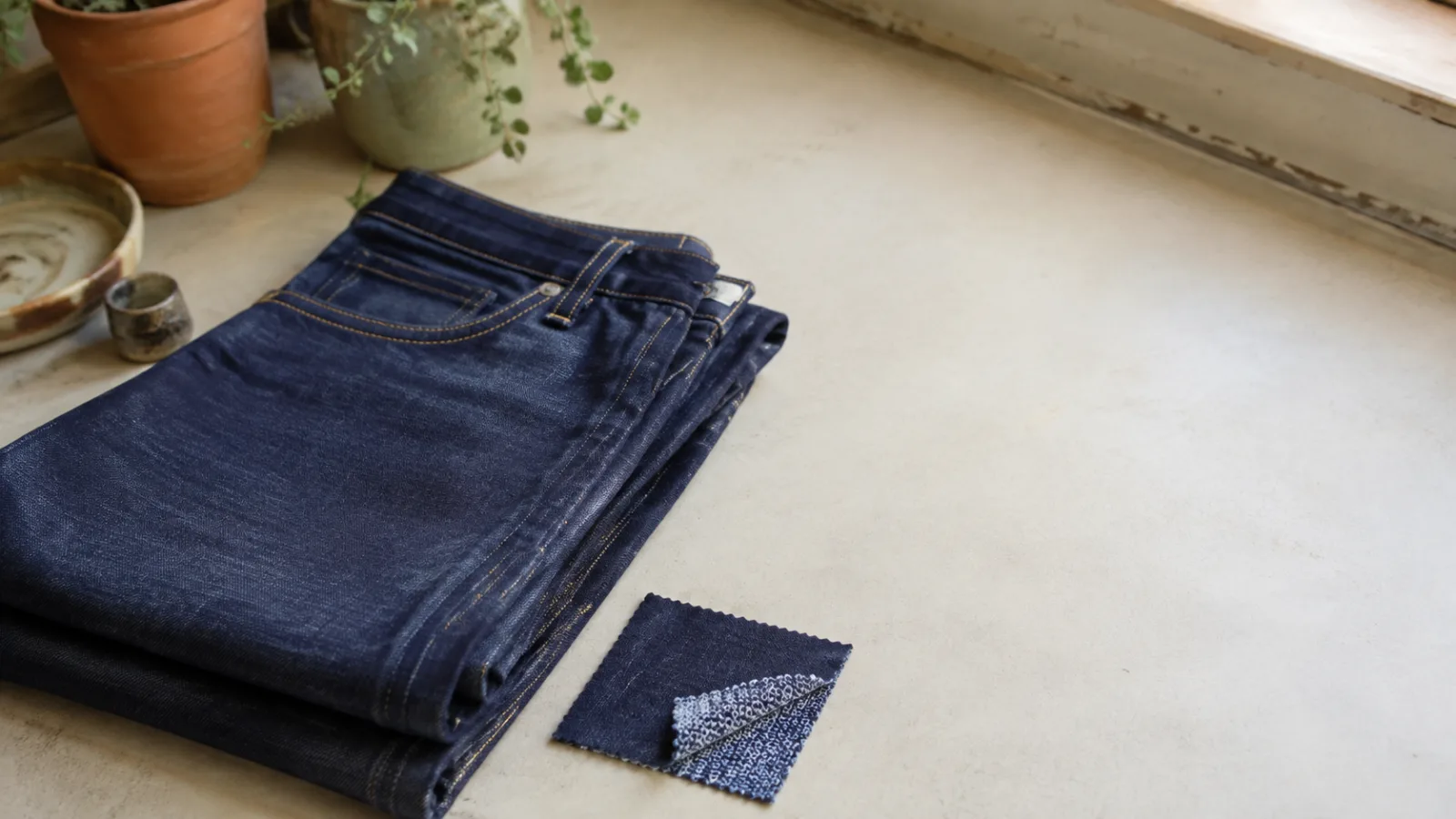
What are jeggings?
A jegging is a legging cut and constructed like a pant, then finished with denim-style styling details (a waistband, belt loops or faux belt loops, and pocket stitching printed or sewn onto the surface) on a fabric that is knit rather than woven. The base cloth is almost always a cotton/polyester or cotton/rayon jersey or ponte knit carrying elastane, not a woven denim twill. That knit base is what separates a jegging from a pair of stretch jeans that happens to look slim: a woven fabric, however much elastane it holds, still has a warp and a weft and a maximum recovery stretch; a knit stretches in every direction because its structure is interlocking loops, not crossed threads.
What distinguishes jeggings from similar pants?
- Knit (jersey or ponte) base fabric, not a woven denim twill -- the single most reliable way to tell a jegging from stretch jeans by touch or by the fabric content label
- Denim-style surface details (topstitching, faux fly, faux pockets, belt loops) applied to a knit body rather than functional construction cut into a woven fabric
- No structural fly in most designs -- a flat, seamless front panel with printed or top-stitched fly lines standing in for a working zipper
- Pull-on entry almost universally, with an elastic or wide-knit waistband rather than a button-and-zip closure
- Skims the leg through the calf and ankle the way a legging does, rather than tapering with a woven fabric’s stiffer hand
How are jeggings constructed?
Cut from a single or near-single knit panel per leg, with side seams and an inseam but rarely the multi-panel yoke-and-gusset construction used in tailored trousers. Because the base fabric already stretches in every direction, jeggings do not need the eased seams, darts or gussets that woven garments use to add ease at the knee and seat -- the knit itself provides that ease. Faux pockets are usually a printed or top-stitched outline with no functional bag behind it; where a real front pocket exists, it is typically a shallow welt sewn directly into the knit rather than the deeper bag-and-facing pocket of a woven jean.
What fabrics are jeggings typically made from?
Cotton/polyester or cotton/rayon jersey and ponte knits, typically in the 4–10% elastane band. At the low end of that band (4–8%) the fabric behaves like the "recovers" category described in our fabric guide -- it stretches enough to sit and crouch and pulls back afterward, similar to pull-on jeans. Above roughly 10% elastane, a jegging fabric starts to behave like a true legging: it stretches in every direction and follows the body rather than holding its own shape. Sueded or brushed-back knits (sometimes marketed as "jean-look" ponte) trade some stretch recovery for a denim-like surface texture.
What waistband structures do jeggings use?
Almost always a full elastic waistband or a wide knit waistband -- the two waistband types built for a garment with no structural fly. A small minority of jeggings use a contour waistband with a flat front panel and elastic only at the back (elastic-back-only), aiming for a smoother look under a fitted top. True button-and-zip waistbands on a jegging are rare enough to be the exception, and when present usually signal the garment is closer to stretch jeans in construction than to a jegging as defined here.
What pocket structures do jeggings have?
Faux front pockets (a printed or top-stitched outline with no opening) are the most common front treatment, since a functional pocket bag is harder to set into a knit without adding bulk that fights the close fit. Back pockets are more often real, since a patch pocket is simple to top-stitch onto a knit panel without needing an internal bag. Side-seam pockets, when present, sit closer to a legging’s hidden-waistband pocket than to a jean’s angled pocket.
How much stretch do jeggings have?
Stretches in every direction (four-way stretch) because the fabric is knit, not woven -- pulling the waistband, thigh or calf stretches the adjacent fabric too, unlike a woven fabric where stretch is mostly confined to the direction the elastane yarn runs. Recovery speed and how much the knee or seat area bags out over a day’s wear depends heavily on elastane percentage and knit density, which is why two jeggings with the same nominal size can feel very different by evening.
How do jeggings fit?
Close through the entire leg from waistband to ankle, following the body’s outline the way a legging does rather than skimming and then breaking at the knee the way a jean does. Because there is little structural ease built into the garment (the stretch itself provides the ease), fit is driven almost entirely by the size chart’s body measurements rather than by garment measurements -- there is no real "roomy through the thigh" cut the way there can be with a wide-leg jean.
What sizing system do jeggings use?
Sized on body measurements (numeric size or XS–XXL) rather than the waist/inseam pairs used for jeans, since the knit fabric is expected to stretch to the body rather than the garment being cut to a fixed finished measurement. Petite and tall inseam options exist in some ranges but are less standardized across brands than they are for woven trousers.
What are the advantages of jeggings?
- Combines a denim-styled look with a knit garment’s stretch and pull-on convenience
- No structural fly or waistband closure to fit around, which can suit a body shape that changes over the day or over a cycle
- Typically lighter and less bulky than jeans, useful for layering under boots or a longer top
What are the trade-offs of jeggings?
- Faux pockets are usually non-functional, so a jegging often cannot hold a phone or keys the way jeans can
- Knit fabric shows wear (pilling, knee bagging, seat sag) differently and sometimes sooner than woven denim, especially at lower elastane percentages
- The absence of a structural waistband closure means less adjustability than a button-and-zip garment offers across a range of waist sizes
What fit problems are common with jeggings?
- Knee bagging and seat sag appearing within a single day’s wear, most common in lower-elastane (4–6%) jerseys under repeated sitting
- Waistband rolling or digging in at the natural waist when the elastic width or recovery does not match the wearer’s waist-to-hip difference
- Sheerness or show-through at the seat and thigh in lighter-weight knits, particularly in lighter colors
- Faux fly and pocket stitching puckering or distorting once the knit has stretched repeatedly around the hip
How do you care for jeggings?
Elastane is damaged far more by heat than by stretching or normal wear, so a hot dryer or hot wash is the most common cause of a jegging losing its recovery and starting to bag out permanently. Cold or warm washing and air- or low-heat drying preserves recovery substantially longer than a standard hot cycle.
What sub-types of jeggings exist?
Denim-look jegging
The most common sub-type: an indigo or dark-wash knit with printed or top-stitched fly and pocket details designed to read as denim from a short distance. Typically 4–8% elastane cotton/poly jersey.
Ponte jegging
Built from a denser double-knit (ponte) rather than a lighter jersey. Holds its shape more like a stretch trouser, sheds less pilling, and is often marketed for office wear rather than casual denim-replacement.
Sculpting or shaping jegging
Adds a firm- or medium-compression panel (see compression level) at the front waist and upper thigh, distinct from the light compression of a standard jegging. Functionally closer to shapewear-with-denim-styling than to a plain jegging.
High-shine or coated jegging
A jersey or ponte base with a surface coating (wax, foil or PU-look finish) that reads visually closer to a legging fashion piece than to denim, while keeping the pull-on jegging construction underneath.
How do you tell jeggings apart from similar categories?
| Question | If yes | If no |
|---|---|---|
| Does the fabric label list a knit (jersey, ponte, interlock) rather than a woven denim twill? | Consistent with a jegging or a legging. | This is a woven garment -- stretch jeans or pull-on jeans, not a jegging. |
| Does the fly close with a real zipper and button, rather than a printed or top-stitched outline? | Leans toward stretch jeans, even on a stretch-heavy fabric. | Consistent with a jegging. |
| Does the garment have denim-style surface details (topstitching, belt loops, pocket outlines)? | Consistent with a jegging. | Without denim styling on a knit base, this is more simply a legging. |
| Is the waistband elastic or wide-knit across the whole waist, with no rigid waistband facing? | Consistent with a jegging or legging. | A rigid or partial waistband suggests pull-on jeans or stretch jeans. |