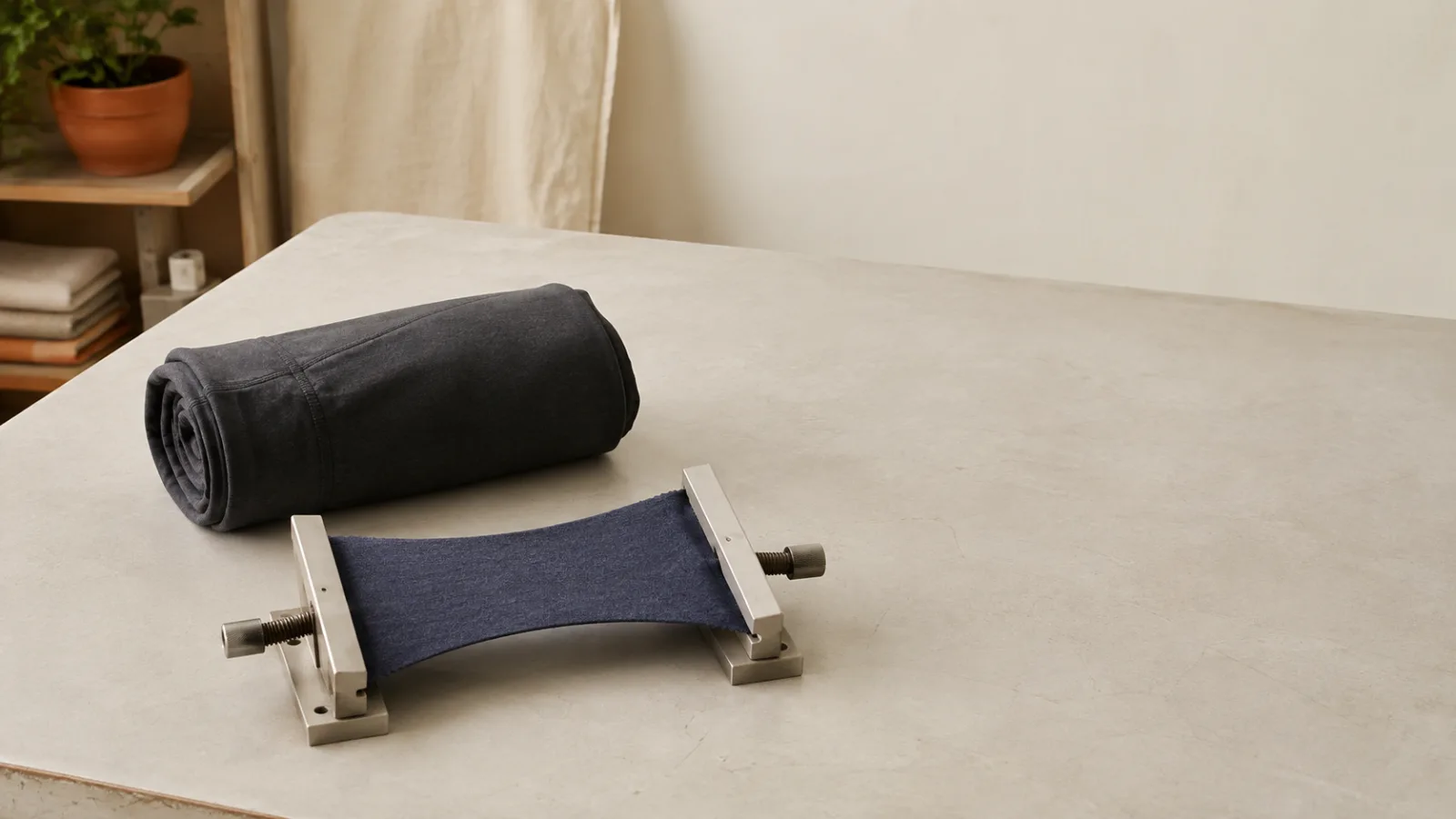
What are leggings?
Leggings are a knit garment with no denim or trouser styling at all -- no fly, no belt loops, generally no pockets, and no attempt to imitate woven-garment construction. They sit at the far end of the stretch spectrum from rigid denim: a high-elastane knit (commonly 10% or more) that is meant to move with the body rather than hold any independent shape.
What distinguishes leggings from similar pants?
- No denim-style or trouser-style surface details -- no faux or real fly, no belt loops, minimal or no topstitching mimicking woven construction
- Highest typical elastane content of any category on this site, commonly 10% or more, giving the most complete four-way stretch and body-contouring fit
- Waistband is almost always a plain elastic or wide-knit band with no attempt at a rigid or contour front panel
- Pockets, when present, are usually a hidden waistband pocket rather than a traditional front or back pocket
How are leggings constructed?
The simplest construction on this site: typically two leg panels and a waistband, with no yoke, no fly extension and minimal seaming beyond what is needed to join the pieces. The high-elastane knit itself provides essentially all of the garment’s fit and ease.
What fabrics are leggings typically made from?
High-elastane knits, commonly nylon/elastane or polyester/elastane at roughly 10–20% elastane, occasionally cotton/elastane blends at the lower end of that range for a softer, less compressive hand. This is the "10%+" band described in our fabric guide, where the fabric behaves less like a garment that recovers after stretching and more like a second skin that continuously conforms to the body.
What waistband structures do leggings use?
Plain full elastic or wide-knit waistbands dominate; a small number of designs use a folded-over waistband that can be worn at two rise heights. Rigid or contour waistbands essentially do not appear in this category.
What pocket structures do leggings have?
Most leggings have no pockets at all. Where a pocket exists, it is typically a hidden waistband pocket sized for a phone or key, rather than a traditional front or back pocket -- the fabric is generally too thin and too stretchy to support a conventional pocket bag without distortion.
How much stretch do leggings have?
Full four-way stretch with the highest elastane content of any category here, so the fabric conforms continuously to body movement rather than holding a fixed silhouette. Recovery is generally fast at this elastane level, though very frequent hot washing still degrades it over time.
How do leggings fit?
Follows the body’s outline completely from waist to ankle with no structural ease anywhere in the garment -- fit is governed entirely by body measurements and the fabric’s compression level (light, medium or firm), not by any cut variation the way a trouser silhouette can vary.
What sizing system do leggings use?
Sized on body measurements (numeric size or XS–XXL), the same convention as jeggings, since the garment is expected to stretch to the body rather than being cut to a fixed finished measurement.
What are the advantages of leggings?
- Maximum range of motion and the closest, most consistent fit of any category on this site
- Simple construction generally means fewer stress points (no fly, no rigid waistband seams) to fail under repeated stretching
- Widest range of compression levels available, from light everyday wear to firm compression designs
What are the trade-offs of leggings?
- No functional pockets in most designs
- Highest risk of visible opacity issues (show-through, especially when stretched over the seat or thigh) among all categories, since the fabric is thin relative to how far it stretches
- No denim or trouser styling, which some wearers want for a more dressed-down or workplace-appropriate look
What fit problems are common with leggings?
- Opacity failure (see-through fabric) at the seat and thigh, especially in lighter colors or lower-weight fabrics stretched to a smaller size than intended
- Waistband rolling down during activity if elastic width or recovery does not match the wearer’s torso shape
- Pilling at inner-thigh contact points over repeated wear, a common wear pattern in high-elastane knits
How do you care for leggings?
Elastane recovery in leggings is damaged primarily by heat, so cold or warm washing and air- or low-heat drying meaningfully extends the useful life of high-elastane fabric compared with routine hot-cycle laundering.