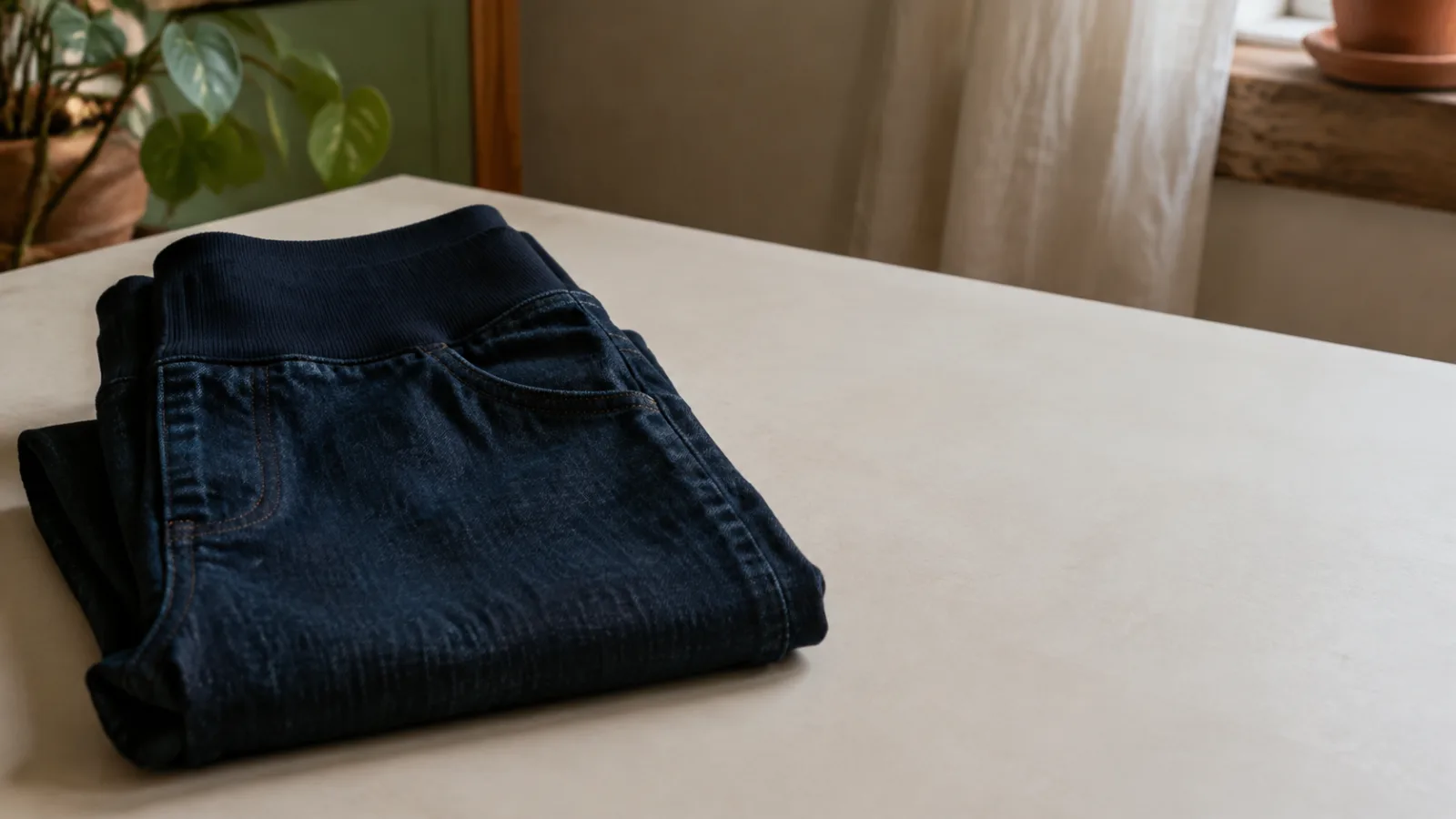
What are pull-on jeans?
Pull-on jeans are woven denim (or a denim-look woven twill) constructed with an elastic or wide waistband instead of a button-and-zip fly, so the garment goes on the way a jegging does but the leg fabric itself is woven, not knit. This is the key distinction from a jegging: pinch the fabric of the leg -- a woven denim has a visible crossed thread structure and stretches mainly in one direction (usually crosswise, along the weft), while a jegging’s knit stretches everywhere.
What distinguishes pull-on jeans from similar pants?
- Woven denim leg fabric (visible warp/weft structure) rather than a knit -- distinguishes it from jeggings even though both are pull-on
- No visible fly hardware; waist closes with elastic, a wide knit panel, or occasionally a hidden drawstring rather than a button and zip
- Real front and back pockets are far more common here than in jeggings, since the woven fabric supports a proper pocket bag
- Often marketed as a comfort alternative to a traditional jean rather than as a legging replacement
How are pull-on jeans constructed?
Cut with the same multi-panel pattern as a traditional five-pocket jean (yoke, front and back panels, waistband) but with the waistband panel built from elastic or a wide knit insert instead of a rigid waistband with belt loops and a fly extension. Pockets, topstitching and belt loops (sometimes decorative, sitting on an elastic waistband with no belt function) are usually real, sewn structures rather than the printed outlines common on jeggings.
What fabrics are pull-on jeans typically made from?
Woven cotton denim blended with 2–8% elastane, depending on how much stretch the design targets. At the lower end of that band (2–3%) the fabric behaves close to a comfort-stretch rigid jean; toward the upper end (4–8%) it approaches the "recovers" behaviour also seen in jeggings, stretching for movement and pulling back afterward.
What waistband structures do pull-on jeans use?
Full elastic or wide-knit waistbands dominate, since the entire point of the category is a fly-free, elastic entry. A drawstring waistband, either alone or paired with elastic, appears in some designs to allow a small amount of manual adjustment that pure elastic does not offer.
What pocket structures do pull-on jeans have?
Real front and back pockets are the norm, built the same way a traditional jean’s pockets are (bag and facing sewn into the woven panel), because the woven fabric can support that construction without adding the bulk it would on a close-fitting knit.
How much stretch do pull-on jeans have?
Stretches mainly in one direction -- across the weft where the elastane yarn runs -- rather than in every direction the way a knit does. Movement ease at the knee and seat comes from the design’s pattern (extra ease built into the cut) as much as from the fabric’s own give, unlike a jegging where the knit itself supplies most of the ease.
How do pull-on jeans fit?
Follows a traditional jean silhouette (straight, slim, bootcut, wide) at the leg, but removes the tightest point of adjustment -- the waistband -- in favor of stretch. The result usually sits close to the actual jean silhouette it imitates rather than skimming the body the way a jegging or legging does.
What sizing system do pull-on jeans use?
Usually sized on the same numeric waist system as traditional jeans (e.g. 27, 28, 29) or in some ranges by letter size, rather than the pure body-measurement charts used for jeggings and leggings, since the leg cut is meant to reproduce a specific jean fit.
What are the advantages of pull-on jeans?
- Combines a traditional denim look and pocket function with elastic-waist comfort
- Real pockets can hold a phone or keys, unlike most jeggings
- Stretch is more predictable and durable over time than a very high-elastane knit, since woven denim structure resists distortion better
What are the trade-offs of pull-on jeans?
- Less overall stretch and body-hugging recovery than a knit garment, since the fabric’s stretch runs mainly one direction
- An elastic waistband on a woven fabric can create more visible waistband bunching under a fitted top than a knit garment’s smoother stretch
- Sizing tends to follow traditional jean waist numbering, which does not always map cleanly to body-measurement size charts used elsewhere on this site
What fit problems are common with pull-on jeans?
- Waistband gapping at the small of the back when the elastic is too wide relative to the wearer’s waist-to-hip ratio
- Fabric that does not fully recover after repeated sitting, especially at the lower end of the elastane range (2–3%)
- Pocket bags adding visible bulk at the hip, more noticeable than on a true jean because the waistband itself is already softer
How do you care for pull-on jeans?
As with any elastane-blended woven fabric, heat is the primary threat to stretch recovery -- a hot dryer breaks down elastane far faster than normal wear does. Turning the garment inside out before washing also reduces surface abrasion on the denim face.