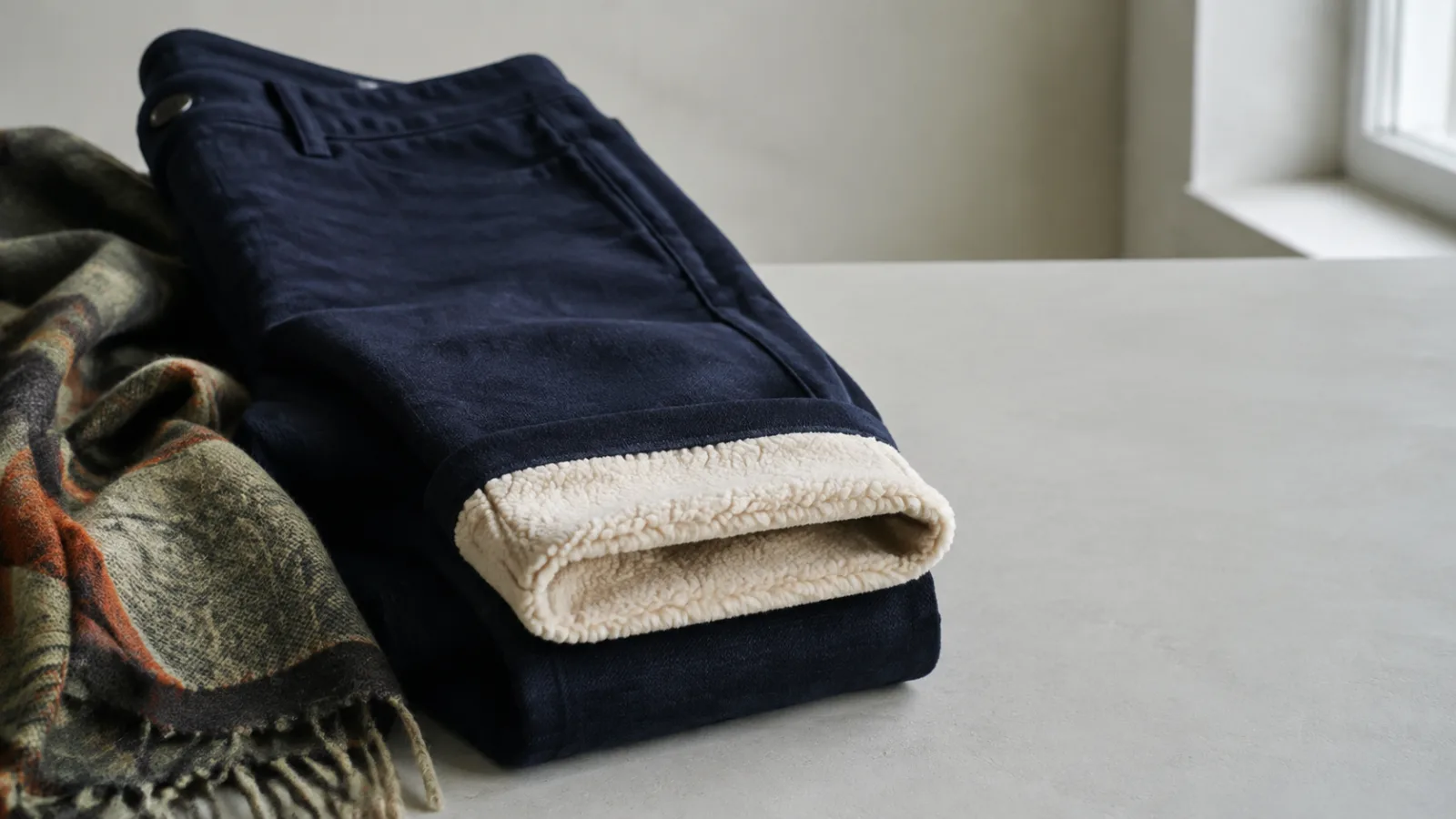
What are fleece-lined pants?
Fleece-lined pants are a cold-weather use-case category: any of the structural categories above (most often jeggings or leggings, occasionally pull-on jeans) built with a brushed fleece backing on the inside face of the fabric for warmth. The defining feature is the interior fleece layer, not the exterior construction, which otherwise follows whichever base category the garment belongs to.
What distinguishes fleece-lined pants from similar pants?
- A brushed or sherpa fleece layer on the inside face of the fabric, distinct and separate from the outer knit or woven layer
- Outer construction (waistband, pockets, styling) matches whichever base category the garment is built on -- most commonly jegging-style knit construction
- Marketed explicitly around warmth and cold-weather wear rather than a specific silhouette
How are fleece-lined pants constructed?
A double-faced fabric: an outer layer (knit or occasionally woven) carrying the garment’s visible styling, bonded or knit together with an inner brushed fleece layer. Seams and pocket construction otherwise follow the base category’s conventions (denim-style faux details on a jegging base, real pockets on a pull-on-jeans base, and so on).
What fabrics are fleece-lined pants typically made from?
An outer face similar to the base category’s typical fabric (often a 4–8% elastane cotton/poly jersey for a jegging-style fleece-lined pant), bonded to an inner polyester or cotton-blend fleece layer. The fleece layer itself typically carries little or no elastane and does not meaningfully add stretch -- the garment’s stretch behaviour still comes from the outer face.
What waistband structures do fleece-lined pants use?
Follows the base category’s typical waistband -- full elastic or wide-knit waistbands are most common since the majority of fleece-lined pants are built on a jegging base, though the fleece lining itself adds bulk that can make an already-snug waistband fit tighter than the same garment without lining.
What pocket structures do fleece-lined pants have?
Follows the base category’s pocket conventions, though the added fleece layer can make faux pockets read as slightly more three-dimensional or make real pockets bulkier than on an unlined version of the same base garment.
How much stretch do fleece-lined pants have?
Follows the base category’s stretch behaviour, with a caveat: the fleece backing adds some resistance to stretch compared with the same outer fabric unlined, since the bonded fleece layer does not stretch as freely as the face fabric alone.
How do fleece-lined pants fit?
Follows the base category’s silhouette (most often a jegging-style close leg fit), but runs measurably bulkier than an unlined version of the same garment because of the added fleece layer -- sizing up relative to an unlined jegging in the same nominal size is a common recommendation for this reason, though the specific product’s size chart should always be checked.
What sizing system do fleece-lined pants use?
Follows the base category’s sizing system (typically body-measurement charts for a jegging base), though buyers should expect a snugger fit than an unlined equivalent at the same nominal size due to the added fleece bulk.
What are the advantages of fleece-lined pants?
- Adds meaningful warmth to a jegging- or legging-style garment without changing its outer appearance
- Retains the base category’s pull-on convenience and general silhouette
What are the trade-offs of fleece-lined pants?
- Added bulk from the fleece layer reduces the close, second-skin fit that an unlined jegging or legging typically offers
- Fleece backing does not stretch as freely as the face fabric, so overall garment stretch is somewhat reduced compared with an unlined version
- Fleece linings generally require gentler laundering than an unlined equivalent to avoid pilling the interior layer
What fit problems are common with fleece-lined pants?
- Tighter-than-expected fit at the same nominal size compared with an unlined version of the same base garment, due to fleece bulk
- Fleece pilling on the interior after repeated washing, especially with high-heat drying
How do you care for fleece-lined pants?
Wash cold or warm and dry on low heat: heat damages elastane recovery in the face fabric the same way it does in any unlined equivalent, and additionally accelerates pilling in the fleece backing.